
SEO
Semrush: Best AI Seo Tool for Marketers?
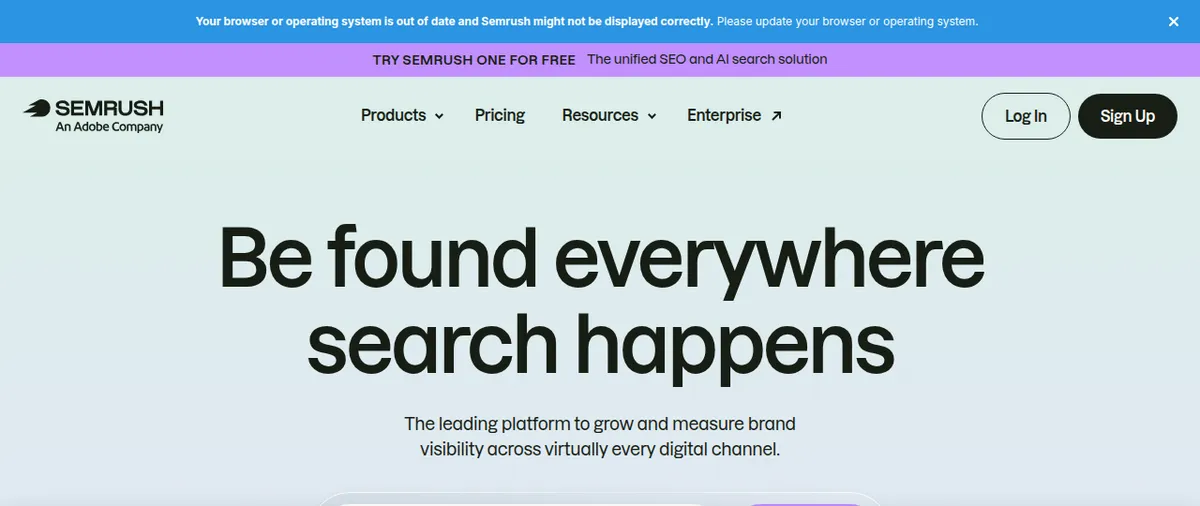
Workflows Semrush appears in
How Semrush connects with other tools
Best for
- Marketing teams running paid + organic channels
- Agencies managing multiple client accounts
- In-house SEO at medium-to-large companies
Not for
- Steep learning curve across dozens of tools
- Price jumps significantly between tiers
- AI features still catching up to dedicated AI tools
Pricing
From: $140/mo
14-day free trial See full pricing →Key features
- Keyword research (26B+ keyword database)
- Competitor analysis
- Site audit
- Backlink analytics
- Position tracking
- Content marketing toolkit
- PPC ad tools
- Social media toolkit
Limitations
- Steep learning curve across dozens of tools
- Price jumps significantly between tiers
- AI features still catching up to dedicated AI tools
Semrush stands as a formidable contender in the digital marketing landscape, offering an expansive suite of tools designed to cover virtually every aspect of online visibility. With a ToolPilot Score of 8.8/10, it consistently demonstrates its capability as a robust platform for professionals seeking deep insights into SEO, marketing, and analytics. At a starting price of $140/month, Semrush targets serious digital marketers, agencies, and businesses that require comprehensive data to inform their strategies.
At its core, Semrush is an all-in-one solution for understanding and improving online performance. It helps users discover keyword opportunities, analyze competitor strategies, audit websites for technical SEO issues, track backlink profiles, and even manage content creation and social media campaigns. Its breadth of functionality means it serves a diverse user base, from solo SEO consultants and content strategists to large marketing departments and digital agencies. Positioned as a market leader, Semrush is often benchmarked against other top-tier platforms like Ahrefs and Moz, distinguishing itself through a particularly strong focus on competitive intelligence across multiple channels.
While its comprehensive nature is a significant advantage, the sheer volume of features can present a learning curve for new users. However, for those committed to leveraging data-driven insights to dominate their niche, Semrush provides the necessary tools. Its primary categories — SEO, marketing, and analytics — barely scratch the surface of its capabilities, which also extend into areas like local SEO, PR, and even Amazon marketplace research. Semrush is best suited for those who need a unified platform to not only monitor their own performance but also to dissect and respond to the ever-changing competitive landscape.
Score Breakdown
Quality: 9.0/10 – Semrush delivers consistently high-quality, comprehensive data across its extensive toolkit, making it a reliable source for critical marketing insights and strategic planning.
Pricing Value: 8.5/10 – At $140/month, Semrush offers substantial value given the sheer breadth and depth of its features, though the entry-level cost can be a consideration for very small businesses or independent operators.
Ease of Use: 8.5/10 – While the platform’s vast capabilities can initially feel overwhelming, Semrush provides intuitive dashboards and a logical structure that makes navigation and data interpretation manageable with some dedicated learning.
Integrations: 8.8/10 – Semrush offers solid integration capabilities, allowing users to connect with platforms like Google Analytics, Google Search Console, and various reporting tools, streamlining workflows and centralizing data.
Support: 9.0/10 – Users generally report positive experiences with Semrush’s customer support, which is responsive and knowledgeable, complemented by an extensive library of tutorials, guides, and webinars.
Use Cases
One common use case for Semrush revolves around competitive analysis and uncovering untapped opportunities. Imagine a marketing manager tasked with increasing organic traffic for an e-commerce store selling specialized hiking gear. Using Semrush, they can input their direct competitors’ domains and instantly gain insights into their top-performing keywords, estimated traffic, and backlink profiles. This allows the manager to identify keyword gaps where competitors are ranking but their own site isn’t, or discover high-authority sites linking to competitors that could also be approached for outreach. Furthermore, they can see competitor ad copy and landing pages, informing their own paid search strategies and content initiatives.
Another crucial scenario involves auditing and optimizing a website for peak SEO performance. A webmaster inherits a large, aging website with inconsistent traffic. They can use Semrush’s Site Audit tool to crawl the entire domain, uncovering technical SEO issues such as broken links, duplicate content, slow loading pages, missing H1 tags, and issues with crawlability or indexability. The tool prioritizes these issues by severity, providing actionable recommendations to fix them. Simultaneously, the Content Marketing Toolkit can help the team identify existing content that could be updated and optimized for new keyword opportunities or better engagement, ensuring that every piece of content works harder to attract and convert visitors.
Finally, Semrush is invaluable for developing a comprehensive content strategy and tracking its impact. A content marketing agency needs to plan a year’s worth of blog posts for a B2B SaaS client. They use Semrush’s Topic Research tool to brainstorm high-interest, low-competition topics relevant to their client’s industry, identifying questions users are asking and popular content formats. After content creation, they leverage Semrush to track keyword rankings, monitor organic traffic growth, and analyze backlink acquisition for each piece. This allows the agency to demonstrate ROI to the client, identify which content themes resonate most effectively, and iteratively refine their content strategy based on real-world performance data, moving beyond anecdotal success to data-backed decisions.
Source Transparency
The insights and assessments presented in this review are compiled from a variety of reliable sources. These include aggregated user feedback and ratings from leading review platforms such as G2 and Capterra, which provide a broad perspective on user satisfaction and real-world application. Additionally, information regarding pricing and core features is cross-referenced with Semrush’s official vendor pricing page. Further qualitative understanding is drawn from discussions and shared experiences within professional communities on platforms like Reddit, offering nuanced perspectives on the tool’s performance and value.
Compare Semrush with…
Stacks that include Semrush
Frequently Asked Questions
Ahrefs vs Semrush?
Ahrefs has better backlink data; Semrush has wider coverage and better PPC tools. For marketers, Semrush. For pure SEO, Ahrefs.
Is Semrush worth $140/mo?
For agencies and in-house marketing teams, yes. For solo bloggers, the Pro tier is overkill.
Does Semrush have a free trial?
Yes — 14 days with full Pro tier access.
Does Semrush replace Google Analytics?
No — they answer different questions. Semrush is for competitive research and SEO; GA is your own user analytics.
Can a small team afford Semrush?
The $140 Pro plan is workable for 1–3 people. The $250 Guru tier is the practical floor for content-driven teams.
Does Semrush cover paid search?
Yes — keyword cost, ad copy spying, and PPC research are all included. It's competitive with SpyFu for ad intelligence.
We earn commission on purchases through our links at no cost to you. Learn more.